Thursday, March 27, 2014

Has This New Discovery By Astronomers Confirmed there is a 'Planet X'?


Astronomers have extended the range of our Solar System with the discovery of a new 'dwarf planet' orbiting our Sun. The planet, currently technically labeled '2012 VP113', has an elliptical orbit that brings it to within 80AU of the Sun (an 'AU' is the unit of distance from the Sun to Earth) at perihelion (closest point in its orbit to the Sun) - some three times the distance from the Sun to Neptune - while it gets as far as 450AU away at the other end of its orbit. The object is not unique: astronomers have previously discovered another similar dwarf planet, named 'Sedna'. Indeed, the new discovery, by astronomers Scott Sheppard and Chad Trujillo, hints that there are a multitude of dwarf planets orbiting the Sun in a location known as the 'inner Oort cloud'.
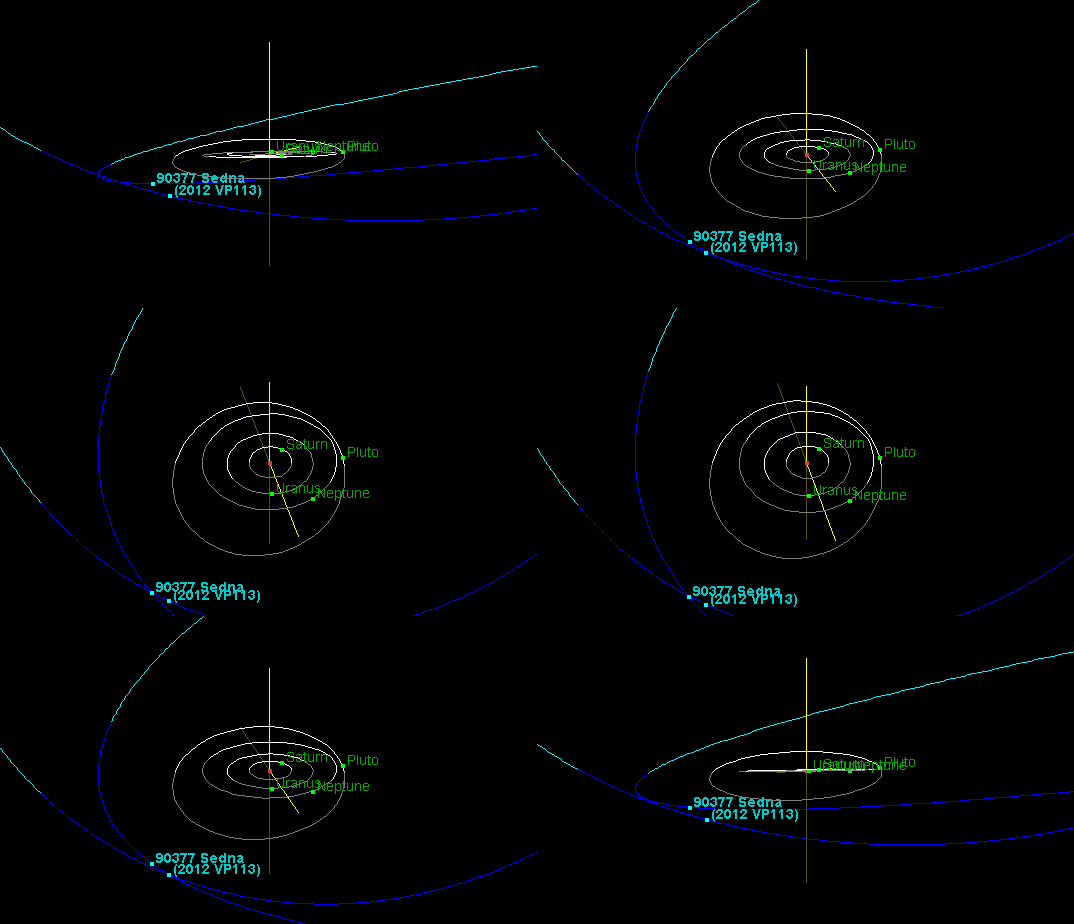
An intriguing coincidence is that the current positions of both Sedna and 2012 VP113 - which are also near both their perihelions - are very similar, leading to some speculation of an unknown, massive body orbiting our Sun well beyond our current sensing abilities - a 'Planet X':
The latest work has already thrown up an intriguing possibility. The angle of the body's orbit and that of Sedna's are strikingly similar, an effect most likely caused by the gravitational tug of another, unseen body. One possibility is a "Super Earth" that traces so large an orbit around the sun that it has never been seen.
"If you took a Super Earth and put it a few hundred astronomical units out, the gravity could shepherd Sedna and this new object into the orbits they have," said Sheppard.
Over at her Planetary Society blog, Emily Lakdawalla has a more detailed breakdown of the discovery, the coincidences, and what it might mean for the Planet X theory. She notes that for a an object of that size to form ('accrete'), it needs to be in a circular orbit - so the elliptical orbit of these two dwarf planets suggests that they were 'scattered' by something at some point after they formed. But the 'Planet X' theory isn't the only possible explanation - the planets may have been thrown into their current orbits by a star that passed within "several hundred AU of the Sun and disturbed orbits of objects it passed near", or it may be due to the fact that Earth was born in a star cluster.

It's really quite striking how close Sedna and 2012 VP113 are to each other right now, both close to their perihelia, both at around 80 AU.Here's an illustration that I put together using the JPL Small-Body Database Browser that shows you just how close they are.
Their current proximity is mostly a coincidence, given the fact that they have different orbital periods; there's nothing about their orbits that says they should be in the same place at the same time, except for the fact that their orbits happen to take them to similar spots in the sky when they are close to the Sun. But we are more likely to discover such objects when they are near perihelion (hence brighter and moving faster), so given the proximity of their perihelia they would've been somewhat close to each other in the sky because that's where we could see them both.
The fact that they have perihelia at similar locations is an interesting observation, though. And it's one that Trujillo and Sheppard noticed, too... They went on to hypothesize that the clustering of argument of perihelia resulted from "a massive outer Solar System perturber" [and] showed that it works for a super-Earth at 250 AU, but "This configuration is not unique and there are many possibilities for such an unseen perturber."
...I have confess to a bias here: I really wanted this coincidence in argument of perihelion to be strong evidence of a planet X. I would love for there to be a planet X. So would Trujillo and Sheppard, evidently, because they spent quite a bit of space showing it could work. And so would Nature, because then the first clear indication of a planet X would be in an article published in their journal.
But Hal [planetary scientist Hal Levison] dashed my hopes, or at least my certainty. "It's a very weak result," he told me; and indeed the paper spends more column inches on what 2012 VP113 tells us about the inner Oort cloud as a population than it does about this potential "perturber."
"There may be other explanations for this, rather than the extreme position of, "it's a planet"; but I can believe there's something going on".
In other words: something threw these planets into their elliptical orbits, but we still don't know what. Watch this...errr...space.
Source: Daily Grail

Saturday, March 22, 2014

We Need Three Planets to Keep the Human Race Alive, NASA Scientist Says.

It’s no secret that uncurbed climate change and population growth are going to (and already have) put stress on the planet. But the situation is getting so bad that one prominent NASA scientist says we have to start thinking about terraforming Mars and that, in order for the human race to survive at current levels, we will eventually “need at least three planets.”
“The entire ecosystem is crashing,” Dennis Bushnell, chief scientist of NASA’s Langley Research Center said Thursday. “Essentially, there’s too many of us. We’ve been far too successful as the human animal. People allege we’re short 40-50 percent of a planet now. As the Asians and their billions come up to our living systems, we’re going to need three more planets.”
Bushnell was discussing the release of The Millennium Project’s “State of the Future,” an annual report that looks at global challenges and how they might be solved. He said that Mars is a good start, but we’d soon need even more space to live.
“If NASA terraforms Mars, that’ll take about 120 years, and that’s only one planet,” he said. “We’d need more shortly.”
It’s not the first time someone has floated the need for humans to colonize other planets, but usually such ideas are proposed as a way for the human race to survive in the event of a cataclysmic asteroid collision or nuclear war. In 2012, the World Wildlife Fund also suggested the three-planet idea, stating that we're using about 50 percent more resources than the Earth can support, and that by 2050 we’d need three planets to sustain that rate.
Bushnell didn’t say when he thought we might need three planets or what planets those might be—Mars is a good start, but beyond that, the Solar System is looking pretty barren as far as terraform-able planets go. 
"The point isn’t to be alarmist or cynical, says Jerome Glenn, CEO of the Millennium Project. It’s about identifying the challenges Earth faces and finding a way to rise above them. “We have no right to be pessimistic. We have to find out what’s intelligent to do to make this species survive,” he told me. “If you think the problems aren’t going to get better, then why try. And if you think there aren’t problems, then why change anything?”
In any case, Bushnell wasn’t suggesting that we absolutely need to leave the Earth—he was saying that we need to stop consuming like we are. He’s got one solution in mind: Salt water farming.
Halophytes, a class of plant that grows well in salt water, could potentially be used to create biofuel by growing plants in the middle of the oceans (or at least using salt water to irrigate plants we do have in agriculturally-unproductive parts of the world). Scientists are working on the possibility, and an MIT project suggested that some pilot programs started in India, Pakistan, Laos, Algeria, and other poor countries should be started sometime this year, but so far, not much progress has been made. Bushnell says it’d solve most of our problems.
“If you grew halophytes on wastelands using seawater, in 10-15 years you’d have fuel that cost $50 a barrel. That’s half of what petroleum costs today,” he said. “With that, you could solve land, food, water, energy, and climate. All of that comes together.”
If we can’t do that, it just may be time to start buying land on Mars.

Source: MOTHERBOARD

Friday, March 21, 2014

A Massive Solar Superstorm Nearly Blasted The Earth In 2012.


Back on July 23, 2012 a furious solar magnetic storm just grazed our planet. Had it erupted just nine days earlier, it would have hit us, causing extensive damage to our technological infrastructure. It would have been a geomagnetic catastrophe the likes of which we've never seen. Scientists say the close shave should serve as an important wake-up call.
We actually have a precedent for such an event, but it happened back in the mid 19th Century. It was called the Carrington Event of 1859, and it damaged the few electronic devices that existed at the time, namely telegraph systems. The solar blast managed to shock some telegraph operators and set fire to their offices. It even caused the Northern Lights to shine so bright and so far south that people could read newspapers by its red and green glow as far as Mexico.
More recently, a severe magnetic storm in 1989 wreaked havoc on Canada's Hydro-Quebec power grid, resulting in a power-out that kept six-million people without electricity for nine hours.

Back To The Dark Ages

Several years ago, the National Academy of Sciences estimated that, if a Carrington-like event occurred today, it could cause $1- to $2-trillion in damages to our civilization's high-tech infrastructure and require four to ten years for complete recovery. Last year, Lloyds put out a study showing that geomagnetic storms could cause upwards of $2.6 trillion in damages across the globe.
And what a headache it would be. An event like this would damage everything from satellites, emergency services' systems, hospital equipment, banking systems, and air traffic control devices, through to everyday items such as home computers, iPods and GPSs. Because of our heavy reliance on electronic devices, which are sensitive to magnetic energy, the storm could leave a multi-billion dollar damage bill and cataclysmic-scale problems for governments.
Worse than this, however, would be the potential length of blackouts. According to a Metatech Corporation study, an event like the 1921 geomagnetic storm would result in large-scale blackouts affecting more than 130 million people and would expose more than 350 transformers to the risk of permanent damage. It could take months—if not years—to put everybody back on the grid.
And as a new analysis from UC Berkeley's Ying D. Liu and Janet Luhmann show, it almost happened two years ago.

A Perfect Solar Storm

Using data detected by NASA's STEREO A spacecraft, the researchers concluded that a huge outburst on the sun on July 22, 2012 propelled a magnetic cloud through the solar wind at a speed of more than 2,000 kilometers per second — nearly four times the typical speed of a magnetic storm. It violated our orbit, but Earth and all the other planets were on the other side of the sun at the time.
When the storm hit STEREO A it was about 120 degrees ahead of the Earth (west of the Earth). Had it occurred nine days earlier — one third of the rotation period of the Sun (which takes 27 days to complete one rotation) — it would have propagated directly towards the Earth.
Here's what it looked like from STEREO's perspective:
The outburst was generated by two nearly simultaneous coronal mass ejections (separated by about 10 to 15 minutes), releasing energies equal to about a billion hydrogen bombs. But that alone wasn't enough to create the intensity observed. According to the analysis, the incredible speed of the magnetic cloud was possible because of another mass ejection four days earlier which had cleared the path of material that would have slowed it down.
The storm also produced a long-duration, southward-oriented magnetic field, which made it all the more dangerous. This is a nasty orientation owing to Earth's northward field. This causes a process called reconnection, resulting in a violent merger.
"These gnarly, twisty ropes of magnetic field from coronal mass ejections come blasting from the sun through the ambient solar system, piling up material in front of them, and when this double whammy hits Earth, it skews the Earth's magnetic field to odd directions, dumping energy all around the planet," explained Luhmann in a statement.

Predicting the Weather

According to the researchers, this event is not as rare as it might seem. It could have easily been missed if STEREO A (the spacecraft ahead of us in Earth's orbit) had not been there to record it.
"People keep saying that these are rare natural hazards, but they are happening in the solar system even though we don't always see them," noted Luhmann. "It's like with earthquakes — it is hard to impress upon people the importance of preparing unless you suffer a magnitude 9 earthquake."
Indeed, preparation is possible. Further study of solar superstorms and the sun's 11 year cycle should help our predictive abilities. But we also need to create more robust technologies to protect ourselves for this eventuality. NASA, for example, has proposed a solar shield to protect power grids from geomagnetic storms. We certainly need to start thinking along these lines to prevent a world-changing catastrophe.

Source: io9