Mars One, a nonprofit organization that links donors with private aerospace companies in hopes of building a Martian colony in 2023 (and then turning it into a reality TV show), sounds too weird to be true—but it has big names, big money, and a realistic-looking plan of action behind it. They haven’t yet picked out the 24 people who will take a one-way ticket to Mars and spend the rest of their lives there, but that part shouldn’t be a problem; over 200,000 candidates have applied, and they’ve whittled the list down to 1,058 finalists.
Mars One has a nice promo/solicitation-for-funds video here which explains the process, perhaps best summed up by the phrase “completely implausible-sounding idea that kind of makes sense when you look at it step by step”:
So while they get the other hardware (and funding) in line, how exactly do they plan to eliminate 98% of the finalists from the candidate pool? By sticking them in Mars-ish simulations right here on Earth, allowing prospective colonists to experience all the comforts of the rugged Martian frontier with none of the existential horror that one might reasonably expect to encounter after being stranded on Mars.
This is a 3D visualization of the Hubble Deep Field image, and it gives you a tantalizing glimpse of what it might be like to fly at extreme speeds through the vast regions between galaxies.
The HubbleSite has made several 3D visualizations of deep space images available on a special area of their site, and it's worth watching all of them — they are glorious. Plus, they offer a complete explanation of what you're seeing and how the visualization was created, sometimes from non-visual data. Here's what they have to say about the Deep Field image:
In 2004, the Hubble Ultra Deep Field (HUDF) provided a ground-breaking view of distant galaxies. In 2009, those data were augmented with new infrared observations to create the HUDF-IR. In 2012, the Hubble eXtreme Deep Field (HXDF) combined those images along with a complete census of archival datasets to see yet farther into the universe. The HXDF contains roughly 5,500 galaxies stretching over 13 billion light-years of space, and represents astronomy's deepest view into the cosmos.
This scientific visualization depicts a flight through the HXDF galaxies. Using measured and estimated distances for approximately 3,000 galaxies, astronomers and visualizers constructed a three-dimensional model of the galaxy distribution. The camera traverses through the thirteen-billion-light-year dataset and ends in blackness, not because more distant galaxies do not exist, but because such galaxies have not yet been observed. For cinematic reasons, the exceedingly vast distances in the 3D model have been significantly compressed.
The visualization is credited to F. Summers, L. Frattare, T. Davis, Z. Levay, and G. Bacon (STScI); data was crunched by G. Illingworth, P. Oesch, and D. Magee (UCSC).
Here's another astonishingly beautiful flyby, this time of the Horsehead Nebula:
The Horsehead Nebula is a dark cloud of dense gas and dust located just below the belt of Orion on the sky. A visible light view shows a strong silhouette resembling the horse's head used for a knight in chess. Infrared light, however, reveals a more complex scene, as shown in Hubble's 2013 image. The warm parts of the clouds glow in infrared light, plus longer infrared wavelengths can penetrate deeper into the clouds. A dark and relatively featureless scene is revealed as a glowing gaseous landscape.
This video presents a scientific visualization of the Horsehead Nebula as seen in infrared light. To fill out the widescreen frame, the central Hubble image has been augmented by ground-based observations from the European Southern Observatory's Visible and Infrared Survey Telescope for Astronomy (VISTA). The three-dimensional interpretation has been sculpted to create a wispy and mountainous environment, with stars distributed in an approximate and statistical manner. The computer graphics model is intended to be scientifically reasonable, but not fully accurate. This imaginative traverse provides an inspiring spaceflight experience that brings the celestial scene to life. Source: io9
March 28, 2014: By the time you finish reading this story, you'll be about 1,000 km closer to the planet Mars.
Earth and Mars are converging for a close encounter. As March gives way to April, the distance between the two planets is shrinking by about 300 km every minute. When the convergence ends in mid-April, the gulf between Earth and Mars will have narrowed to only 92 million km--a small number on the vast scale of the solar system.
Astronomers call this event an "opposition of Mars" because Mars and the Sun are on opposite sides of the sky. Mars rises in the east at sunset, and soars almost overhead at midnight, shining burnt-orange almost 10 times brighter than a 1st magnitude star.
Oppositions of Mars happen every 26 months. Of a similar encounter in the 19th century, astronomer Percival Lowell wrote that "[Mars] blazes forth against the dark background of space with a splendor that outshines Sirius and rivals the giant Jupiter himself."
In other words, it's really easy to see.
There are two dates of special significance:
April 8th is the date of opposition, when Mars, Earth, and the sun are arranged in a nearly-straight line.
If the orbits of Mars and Earth were perfectly circular, April 8th would also be the date of closest approach. However, planetary orbits are elliptical--that is, slightly egg-shaped--so the actual date of closest approach doesn't come until almost a week later.
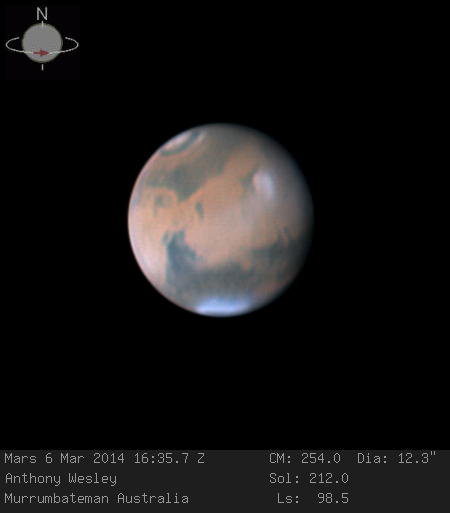
Mars, photographed on March 6, 2014, by Australian amateur astronomer Anthony Wesley using a 16-inch telescope. More
On April 14th, Earth and Mars are at their minimum distance: 92 million km, a 6+ month flight for NASA's speediest rockets. You won't have any trouble finding Mars on this night. The full Moon will be gliding by the Red Planet in the constellation Virgo, providing a can't-miss "landmark" in the midnight sky.
Remarkably, on the same night that Mars is closest to Earth, there will be a total lunar eclipse. The full Moon of April 14-15 will turn as red as the Red Planet itself. A video from Science@NASA has the details.
Although these dates are special, any clear night in April is a good time to look at Mars. It will be easy to see with the unaided eye even from brightly-lit cities. With a modest backyard telescope, you can view the rusty disk of Mars as well as the planet's evaporating north polar cap, which has been tipped toward the sun since Martian summer began in February. Experienced astro-photographers using state-of-the-art digital cameras can tease out even more—for example, dust storms, orographic clouds over Martian volcanoes, and icy fogs in the great Hellas impact basin. The view has been described by some observers as "Hubblesque."
The distances and velocities cited in this story were calculated by JPL's online HORIZONS ephemeris. All velocities are correct for March 31, 2014.
Oppositions of Mars happen every 26 months. The racetrack model of planetary orbits explains why. Earth and Mars are like runners on a track. Earth is on the inside, Mars is on the outside. Every 26 months, speedy Earth catches up to slower Mars and laps it. Opposition occurs just as Earth takes the lead.
Because planetary orbits are elliptical, not all oppositions are the same. In 2003, Mars made its closest approach to Earth in 50,000 years, an apparition that mesmerized sky watchers all over the world. The 2014 opposition of Mars is a much more "run-of-the-mill" opposition--not historic, but beautiful nonetheless.


+(NASA-JPL+April+2005).jpg)