Astronomers have been scratching their heads over a series of mysterious radio bursts, so rare & intense, up until recently many of them even questioned their cosmic origin. First detected in 2007 through
a telescope in Australia, the radio signals are known as fast radio bursts (FRBs) or Lorimer bursts, in honor of West Virginia University astrophysicist
Duncan Lorimer, who was the first to discover & describe them on a
scientific paper.
Since then, fewer than a dozen FRBs have been detected, the last one by the Arecibo observatory in Puerto Rico, on November 2, 2012 --as reported by
National Geographic 2 weeks ago. By now we've only established 3 factors about the bursts: They are incredibly fast (lasting only a few milli-seconds), incredibly bright, and they seem to come from really, REALLY far away (as in
billions of light years away).
But what causes them?
Because the signals are so brief and bright, they must be coming from a rather dense source, says astronomer Scott Ransom of the National Radio Astronomy Observatory. “That means a compact object – i.e., a neutron star or a black hole – is likely somehow to blame,” he says.
Just what that compact object is has yet to be explained. One theory suggests that giant flares erupting from highly magnetic neutron stars, known as magnetars, cause the bursts. Others suggest the bursts result from colliding neutron stars or black holes, evaporating primordial black holes, large magnetic stars, or are the death spasms produced when massive, slowly spinning neutron stars collapse into black holes. That last object, proposed in 2013, is known as a blitzar.
Notice that all these hypotheses have 1 thing in common: they assume the bursts are caused by some natural, albeit exotic phenomena. But would it be so ludicrous to speculate that FRBs have an
artificial origin? That's what I humbly proposed on my Mysterious Universe column
last week; something that could be easily dismissed as the nonsensical delusions of a woo-woo schmuck...
Well, turns out I'm not the
only schmuck wondering about FRBs: In a
comment left at the NatGeo page, none other than SETI founder Frank Drake is
also proposing these mysterious bursts might be good candidates for a signal sent by some advanced civilization:
Indeed, [...] it is a worthy speculation that the FRBs might be a “hailing” message from a distant altruistic civilization. For many years, SETI scientists have speculated about the possible design of a hailing signal — a signal which announces loudly the existence of another civilization, and possibly leads the receiving civilization to a radio channel bearing much information. Without knowing which stars might be the home of other intelligent civilizations, the sending civilization might well adopt a strategy of sending hailing signals to large numbers of potential ETI-supporting stars. To achieve maximum probability of discovery, the right strategy is to send a very narrow-beam, powerful signal. In this case, one can send to only one star at a time, and so the strategy leads to a paradigm in which the transmitting beam is steered to a large number of stars sequentially, leading to the signals being detected possibly as short bursts which may repeat after some long time period. So we should search for more FRBs!
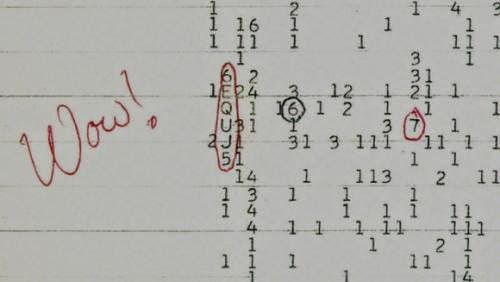
The famous 'Wow!' signal, detected on August 15, 1977, which to this day is still considered the signal closest to filling the criteria of what intelligent ETs would be transmitting through outer space --or at least, the criteria of what modern science currently assumes intelligent ETs would be capable of doing…
There was also a time, when astronomers seriously considered the possibility that pulsars were actually
alien beacons, perhaps built & used by some incredibly powerful space-faring civilization, to help them navigate through the stellar oceans. The fact that both pulsars are now largely considered a natural phenomenon --the same as FRBs-- IMO speak of the current paradigm incongruence we're stuck in: On the one hand, scientists assure us that intelligent life is more than likely widespread throughout the Cosmos; but on the other hand, to propose an observed astronomical event as a sign of these assumed extraterrestrial civilizations, is
still largely regarded as a wild speculation --Martian face, anyone?
Source: Daily Grail


